
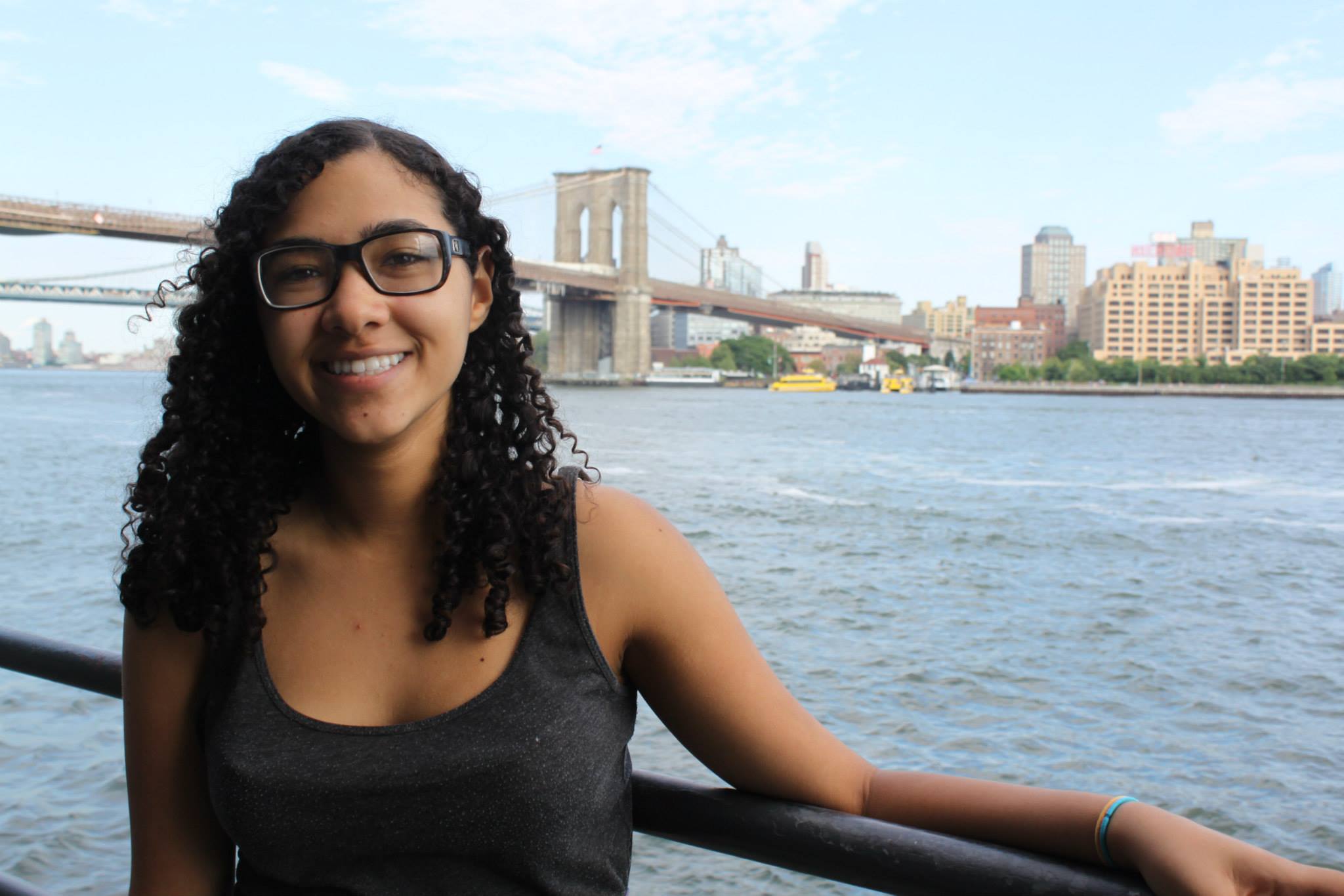
Hometown: Jackson Heights, NY
The Young Playwrights Inc. headquarters are buzzing with excitement as the 2014 National Conference approaches. May Treuhaft-Ali will be one of the writers joining us in January – and we’re introducing you to her here! Her play Rêve D’Amour, Op. 5-2 explores the nature of love and art through a series of dreams that span a lifetime.
How did you first get interested in theater?
I don’t ever remember not being interested in theater. My parents took me to plays when I was a kid. So it sort of has been a lifelong love of mine and I think one day I just sort of asked myself “where do you want to be when you grow up?” And I realized, “Oh, in the theater.” And then the summer between 8th and 9th grade I spent a lot of time at the Drama Book Shop. It’s a phenomenal place and I remember after that summer spending a lot of time there and then just looking in the mirror one day when I was brushing my teeth and being like, “oh, duh. This is what I want to do.”
It’s great that you’ve pursued it so passionately. Do any of your experiences theater-going as a kid really stand out in your memory?
The experiences that really stood out to me actually came later when I was in 9th grade, I remember seeing Next to Normal which had a huge impact on me. I read References to Salvador Dali Make Me Hot by Jose Rivera, and that is actually sitting on my shelf right now at college. That had a huge impact on me, and I play a lot with characters who aren’t human, and I think I definitely got that from that play. I read Sarah Ruhl; she’s another one that’s sitting on my desk right now. Her language is just so beautiful. That impacted me a lot. I saw this really really great play called Song for a Future Generation and it was in a teeny tiny theater Under St. Marks and it was just so cool and so incredible, so that impacted me a lot.
I notice that your plays incorporate other art forms, or at least they seem to draw inspiration from other art forms a lot. Can you talk a bit how that’s been for you? Drawing inspiration from poets and musicians and things like that?
Yeah, this is funny because I always say to myself “I’m going to write a play that doesn’t involve a painter or a pianist.” It has yet to happen. It literally never happens. So this is a funny question. I think art, like visual art and music in particular, have a big impact on my writing because they allow me to play with color and sound and I think that color and sound are so theatrical. Poetry too: it allows you to play with a dimension of language. In a play everybody’s supposed to copy the way people talk in the real world, and when you add some poetry in there you add another language that elevates the register of the dialogue. So having art in my plays gives me more to play with in terms of the sensory information and with the theatrically, and aside from that I’m just really fascinated with what it means to be an artist. It’s something I think a lot about especially because I want to go into theater when I grow up. What is an artist, what is our place in society, what do we do for other people, and how it’s really just sort of striving. When you are creating a piece of art, you can never create it perfectly, you know, it’s never going to fully communicate everything you want it to communicate and it’s never going to—what comes out on the paper, or in the music or whatever it is—is never fully going to be what you envision in your head. And there’s something tragic about that, about that striving. I think a lot of my plays deal with themes of striving for something impossible, of some kind of a state or some transcending of a real life, and I think a lot of that sort of transcendentalism and that escapism is what artists want, and never quite achieve.
I think people who aren’t artists yearn for that too, and that’s a big part of what’s going on in Reve D’Amour. Has your perspective on that striving or that transcendence changed since you started working on this play?
Absolutely. I think in Reve D’amour it’s very important for me to love Max, because he’s the most real character, and he’s everything good that the real world has to offer, and to recognize that he isn’t perfect. He’s never going to be enough but he’s something genuinely good. I don’t believe that (Amelia) should have stayed in Paris and missed her plane and smoked her cigarettes. I think marrying Max was the right thing to do for her. That impossibility, that thing that we are striving for but can never quite reach… it’s important to be friends with that impossibility. It’s important to not let it torture you, and to say, “You know what, this is something I’m never going to achieve, and there’s something beautiful about that. There’s something exciting about that, and even fulfilling about not achieving that. And I can be friends with that.”
It’s a really mature perspective to have on those things. Is that showing up in any new work? Are you working on anything new that’s exploring that idea?
I am working on something new, actually also dealing with an artist—big surprise. The new play I’m working on is about a statue in a subway station who dreams of nothing but being in an art museum. So it actually deals with that theme a lot, because the statue doesn’t feel like he is art enough, and he really just wants to be art. He feels like he can’t fully achieve that in a subway station. And the museum is literally right above his head, and it’s just right out of his reach and he will never get there. So that’s a theme that I think about a lot.
That sounds great. I’m a little sad that you can’t submit it to us because you’ve aged out now! So you’re studying theater at school now?
Yes.
How are your theater classes going?
Well, this semester I took production lab and I was the assistant stage manager for The Seagull, and it’s funny how connected The Seagull is to everything because it’s also about the meaning of art. This idea of enduring for the sake of your art. And I think a lot of my struggle this semester was that I was assistant stage managing, I was on run crew, stuff like that—which is all very important and I really enjoyed doing it, but I felt sort of detached from the artistic process in these plays. And then I realized that I wasn’t actually detached from it at all. Even if you are just building tables, or sweeping the stage, you are contributing to the greater arts of this school. And you’re not just sweeping the stage because you’re sweeping the stage, you’re doing it because you believe in the theatrical process and you believe in your art so deeply that sweeping the stage becomes an act of art in itself.
That’s a great way to look at it. I think the more and more theater you do, you realize how essential every person on the team is. I’m really looking forward to seeing you do another process with your play at Conference.
May Treuhaft-Ali will be joining six other playwrights at the 2014 Young Playwrights Conference in New York City, January 8-16. We will be inviting members of the Young Playwrights family (like you!) to the readings of these talented young writers. If you are interested in attending the readings you can get your tickets by clicking here.
The deadline for writers in the United States aged 18 and under to submit a play to our 2014 competition is January 2nd. Click here for additional information and submission instructions.


